
“We may have years, we may have hours,
– Membrillo, Grim Fandango
but sooner or later, we push up flowers.”

NOURISHMENT
Acrylic and ink on canvas 2025
72 x 96 in
In August 2018, I was in an empty parking lot in Naga City, 3AM.
I had just returned from gathering whatever was left of my belongings in Manila. A suitcase of clothes, two huge bags filled with books, and a hundred pieces of pens I had apparently bought in a frenzy during a manic state.
The incidents that had happened leading to my spontaneous return to my hometown was a blur.
One moment I was working. Then there appeared these contemptuous faces telling me how everything was my fault. The next thing I knew, I was at the south road with my best friend driving me home.
I was a mess.

BENIGN
Acrylic and ink on canvas 2025
60 x 48 in
That year I had just turned 30, dealing with fairly common problems I wasn’t mature enough to handle. I was reeling from a toxic relationship. I got blindsided by people I trusted. I needed to fight the urge to blame myself for making such stupid decisions so as to avoid self-harm. All I knew was, at that moment, I truly felt what it meant to be defeated.
I gathered seven pesos of spare change from my mother’s car because I couldn’t afford a stick of cigarette. I let it burn between my fingers as I looked mindlessly at stray dogs in the dimly lit street I was standing on. I couldn’t even cry. Everything was just… empty.
After a while, it started drizzling. It always rains in Naga. Its geographic position in Southern Luzon makes this possible in a way that it extended towards the Pacific, as if begging the universe to let storm clouds pass through it. So out of the 20 typhoons that would enter the country annually, about 16 of those directly and indirectly affect the region. Floods and power outages are thus more common occurrences in Naga compared to other parts of the Philippines.
I would need to tell you however that when it had started drizzling, I went in the car and drove home. I did not stand in the rain nor slide down with my back against the vehicle for dramatic effect. Stuff like these only happens in movies, or to people who think they are main characters in their lives.
As children, my siblings and I would stay in my parents’ room during typhoons. My mother would fold an empty milk carton and fan us with it until we fell asleep.
As an adult, I realized it was harder for my mother to take care of us. After I returned from my Manila ordeal, Mama had to take a step back to allow me to find my way out of whatever pit I was immersed in.
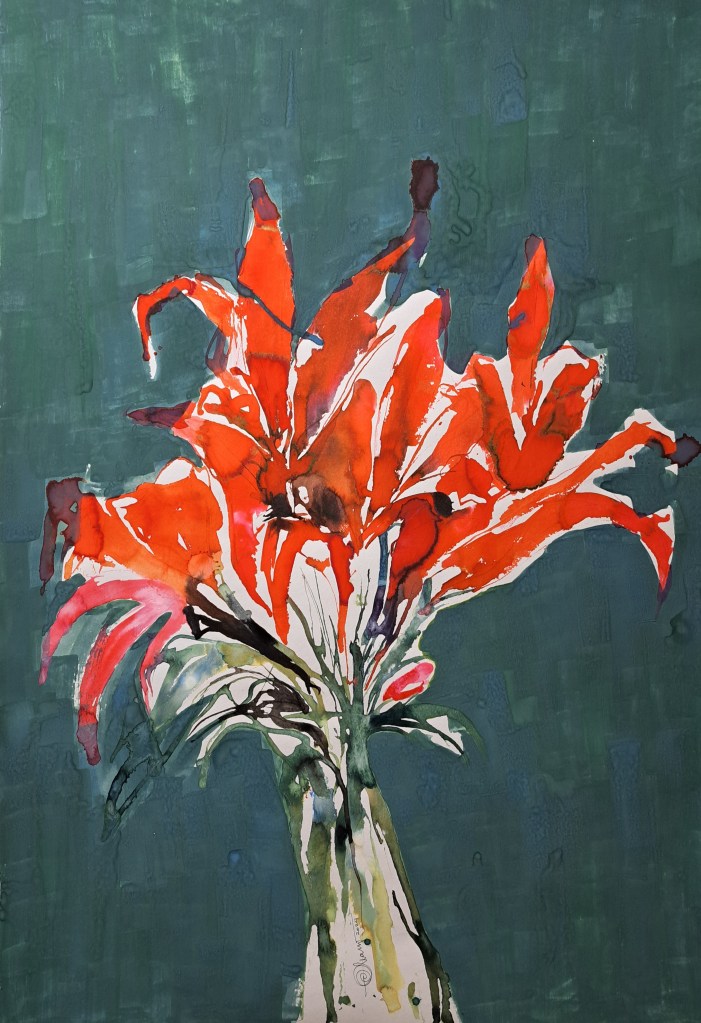
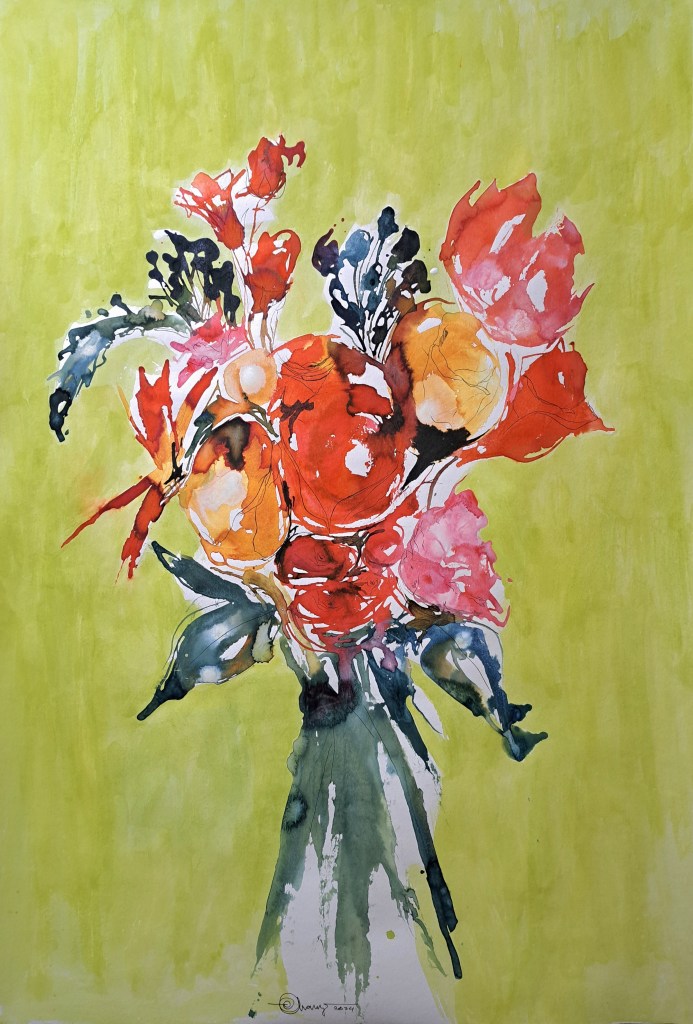
She waited a few weeks to ask me to paint her flowers so she can hang them in the living room. “Make me red ones and blue ones and yellow ones,” she said. “I’ll buy the wood and canvas.”
In the morning I’d paint. I couldn’t in the afternoon because it would rain and I worked in the garage. I began painting, and people began noticing the pieces I was doing and they bought them so finally I was earning.
I didn’t get to work on my mother’s flowers. Every time she would ask, I’d tell her I had to make a living first. She didn’t protest. She would continue cleaning the house as she does every morning and watch her horror shows in the afternoon.
In 2020, at the peak of the COVID-19 pandemic, three consecutive storms ravaged Naga and the Bicol region. The first one to hit was Typhoon Quinta (Molave) followed by Super Typhoon Rolly (Goni), and then Typhoon Ulysses (Vamco).
Rolly was the strongest of the three, recording scales just second to Super Typhoon Yolanda (Haiyan) in 2013. Rolly wiped out the island of Catanduanes. Bikolanos appealed for donations to help the province get back on its feet. Just two weeks after Rolly’s landfall, Ulysses struck Quezon province, causing floods in Central Luzon and Metro Manila. And whenever Metro Manila gets hit, the whole country neglects other places that are also in dire need of help.
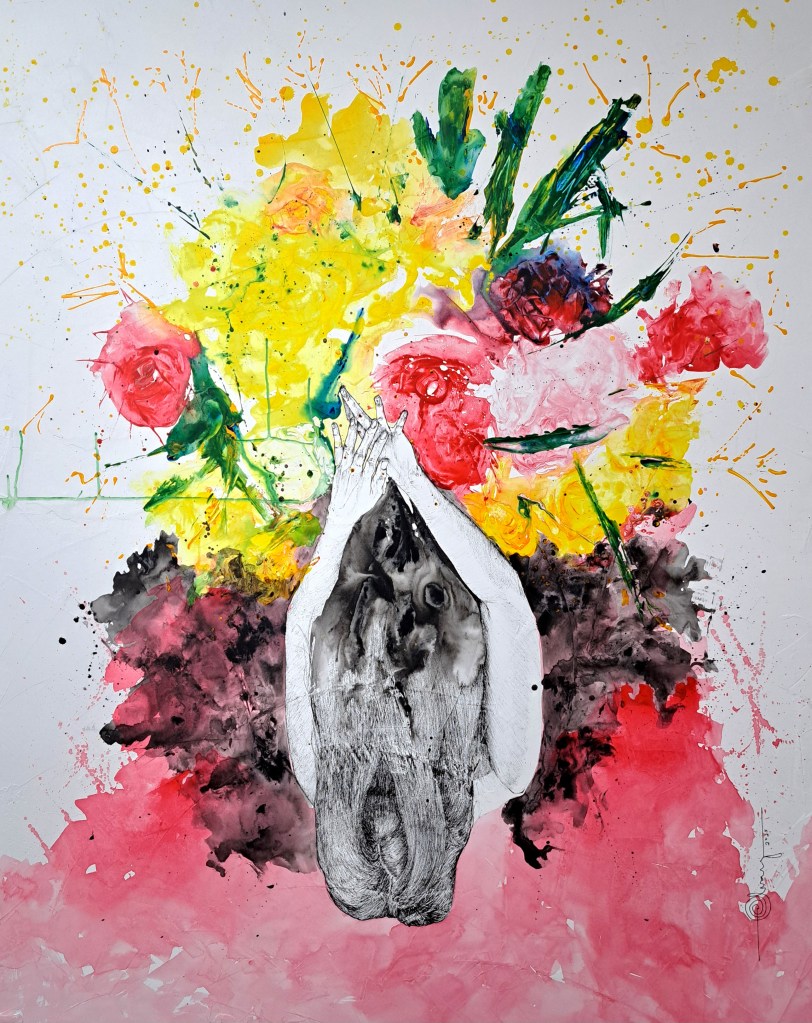
ADMISSION
Acrylic and ink on canvas 2025
60 x 48 in
The funny thing in the aftermath of storms is that people forget. When people start feeling a sense of normalcy, they forget that they’ve been through something horrible and they move on without ever asking if they’ve fully recovered from what happened. The same goes for people in stuck in toxic relationships.
The same goes for me and my mother’s flowers.
In 2024, six years after my mother’s request, I still had nothing to show to her. I gave the same excuse: I had to earn first.
In May, a malignant mass was found in my mother’s colon during a routine checkup. The specialist kept silent; he wanted to first speak doctor to doctor with my brother.
I knew something was terribly wrong.
All the answer we got was that more tests were needed to make an accurate diagnosis. The results came quickly, just within days, and after one would come out, another needed to be taken to be completely sure that the results were correct.
It was painful. My mother is only 60 years old. She was in Manila to visit my youngest sister because she had been feeling lonely in the province. My sister dreams of being an interior designer and it is my mother’s joy seeing her pursue her ambition.
All Mama ever did was take care of us and my father. She seldom traveled nor went out with friends. She would just stay home, clean, decorate the house, and cook even if she hates it. My siblings and I would always talk about taking Mama on a cruise, but until this point none of us have really done anything out of our way for her.
On her sporadic vacation, my brother asked Mama to undergo a colonoscopy just to dispel any signs of poor liver function. And just like that, Mama’s world would turn upside-down, without warning.
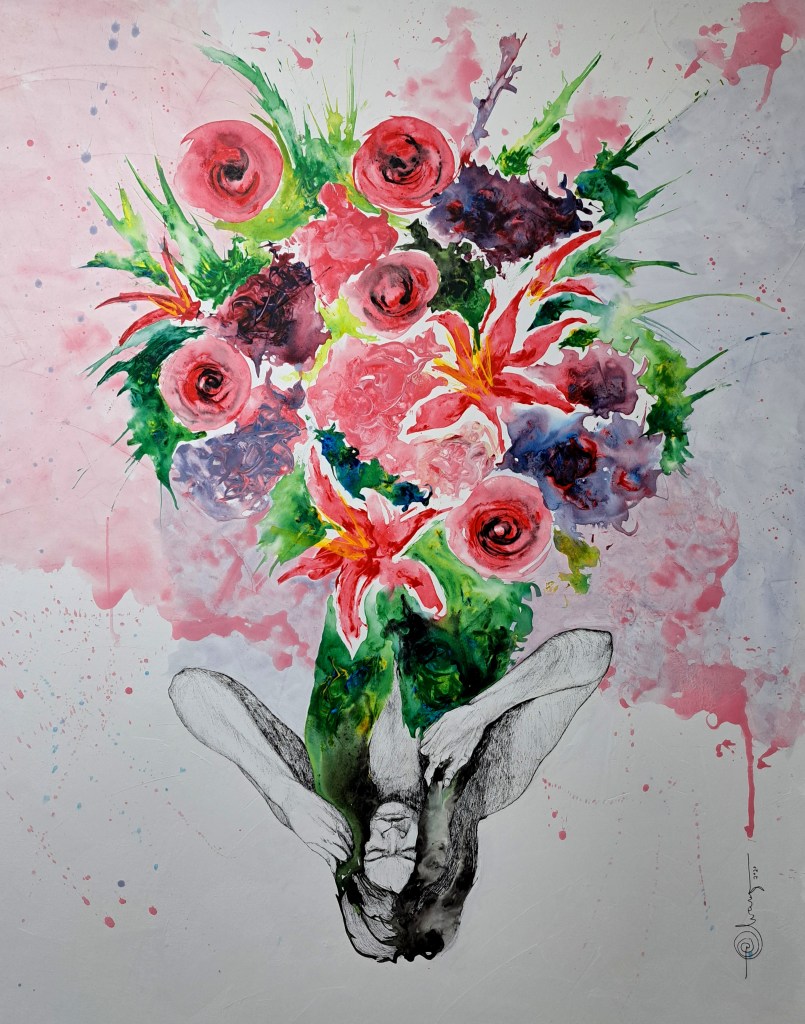
GROOMING
Acrylic and ink on canvas 2025
60 x 48 in
When we spoke, Mama said she was supposed to die of diabetes or heart disease.
“Why do I have cancer?” she asked.
“We don’t know that yet,” I replied.
I felt regret, worry, hope, loss, confusion, and longing all at the same time. I could not stand the thought of her in pain. She’s endured a lot. She doesn’t deserve any of this, especially with me waiting for such dire times before finally starting painting the flowers she would ask for every year.
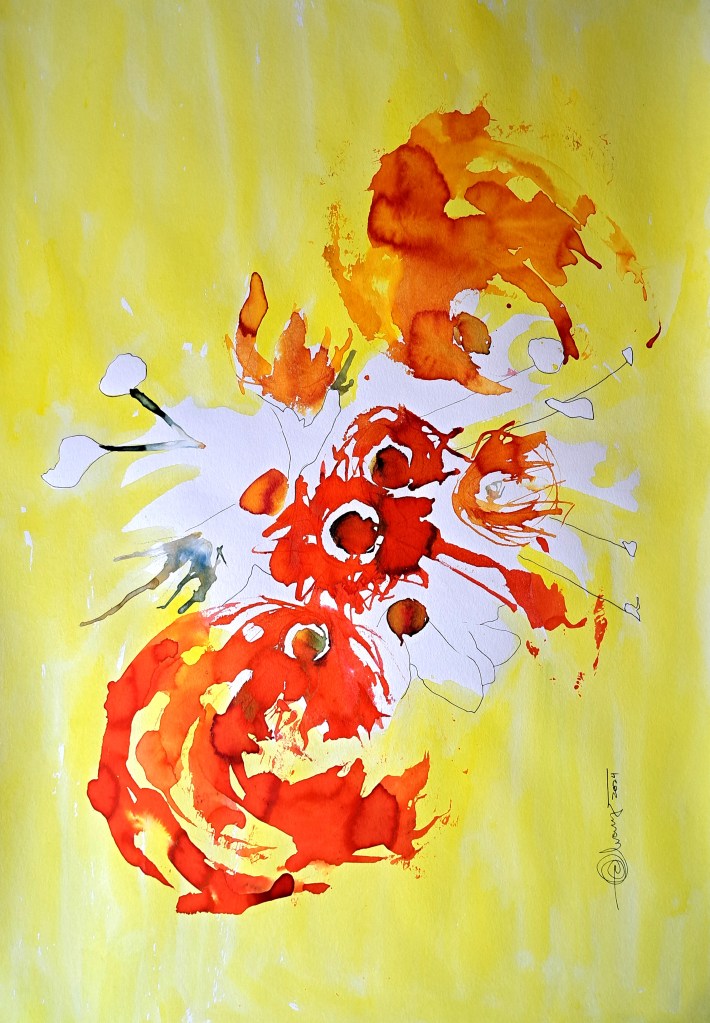
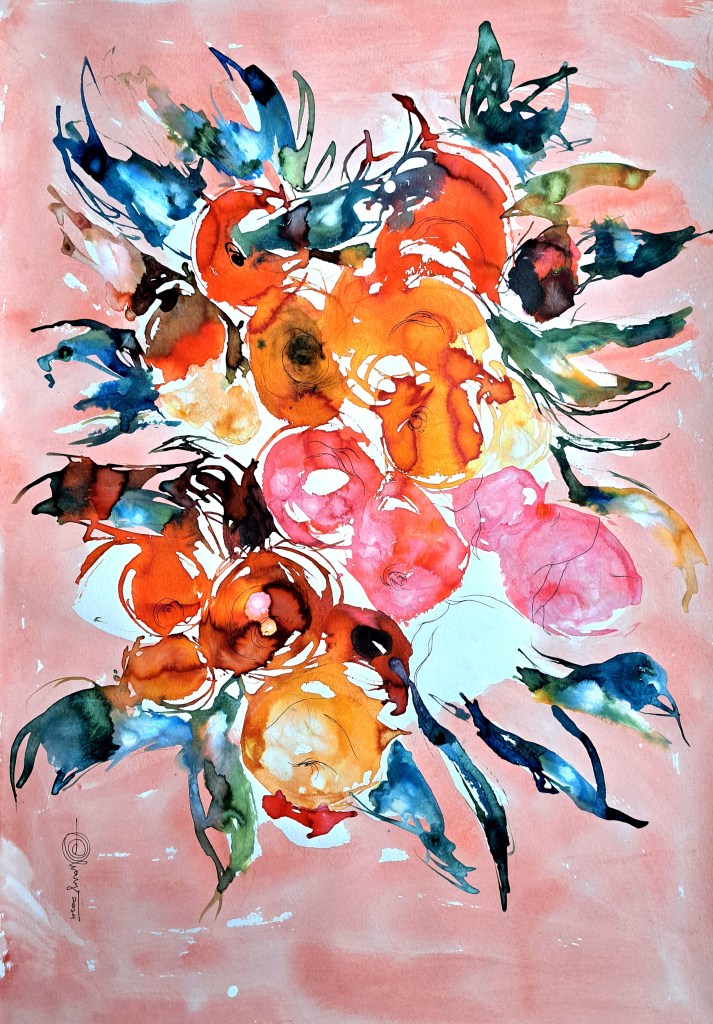
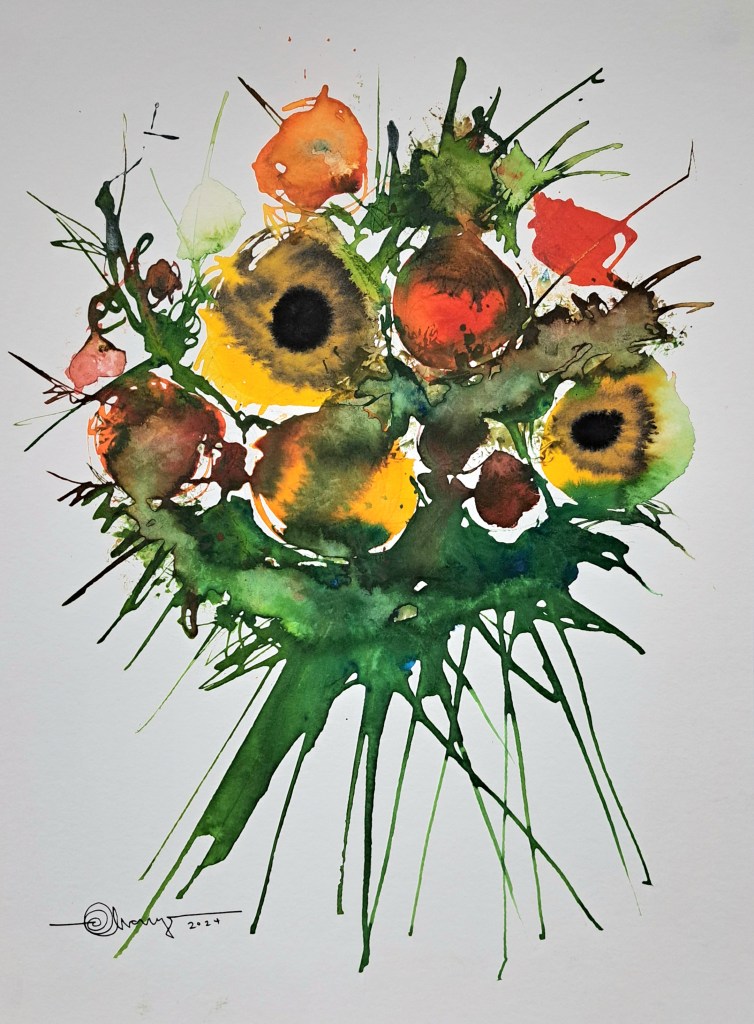
So I painted flowers like a man possessed. I painted as a form of penance: that in some deranged attempt at saving her or making her feel loved, I would paint six years’ worth of flowers and this would somehow heal her. I never imagined a time when I truly meant what I was painting.
A week after the colonoscopy, the oncologist finally broke the news that my mother had a rare type of cancer, the type that should have manifested on her skin but grew elsewhere inside her body. And that this was just the third case he encountered, and there weren’t enough situations to build an informed prognosis on.
“But, for your mom, I would highly suggest we remove it soonest,” said the oncologist. “I would recommend the same if it were my mother or my wife.”
Before her operation, Aghon (Ewiniar), the first typhoon to enter the country for the year, was forecasted to pass through Naga. On her hospital bed, Mama instructed her hanging plants to be brought down and kept in the garage. We asked her not to think about these things and assured her the storm wouldn’t be that bad.
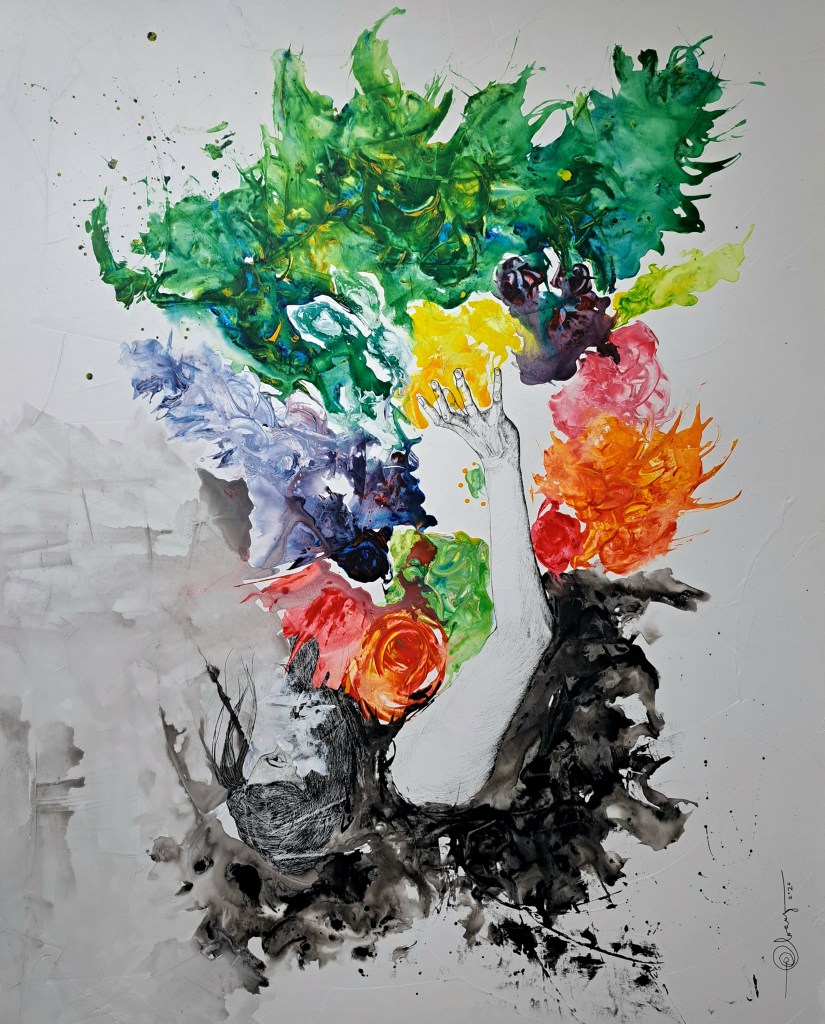
DETERMINED
Acrylic and ink on canvas 2025
60 x 48 in
Following news of my Mama’s sickness, people started opening up to me. I learned that some of my friends’ mothers were going through a similar thing and some were suffering from dementia. These same friends have developed an autoimmune illness and were blaming the vaccine. Some of them were going through the loss of a parent, a spouse, or a child.
One stranger I randomly spoke with pulled the ribbing of her shirt down to expose a scar on her throat. “I survived it (throat cancer). I’ll be praying for your mother,” she said with conviction.
I look at other people now as I would scan the surroundings after a typhoon. That gray atmosphere where we go out to pick up the pieces of our ravaged homes, silently without making eye contact.
Maybe the next time we all start clearing the wreckage, we would all give each other a nod. It’s not much. It won’t help repair homes. But it will send the message that we’re all on the same boat.
As for the flowers, paint yours as soon as you can. The storms are only getting stronger. There’s no telling when we’ll be pushing up flowers.
EXHIBIT PHOTOS courtesy of Altro Mondo Creative Space
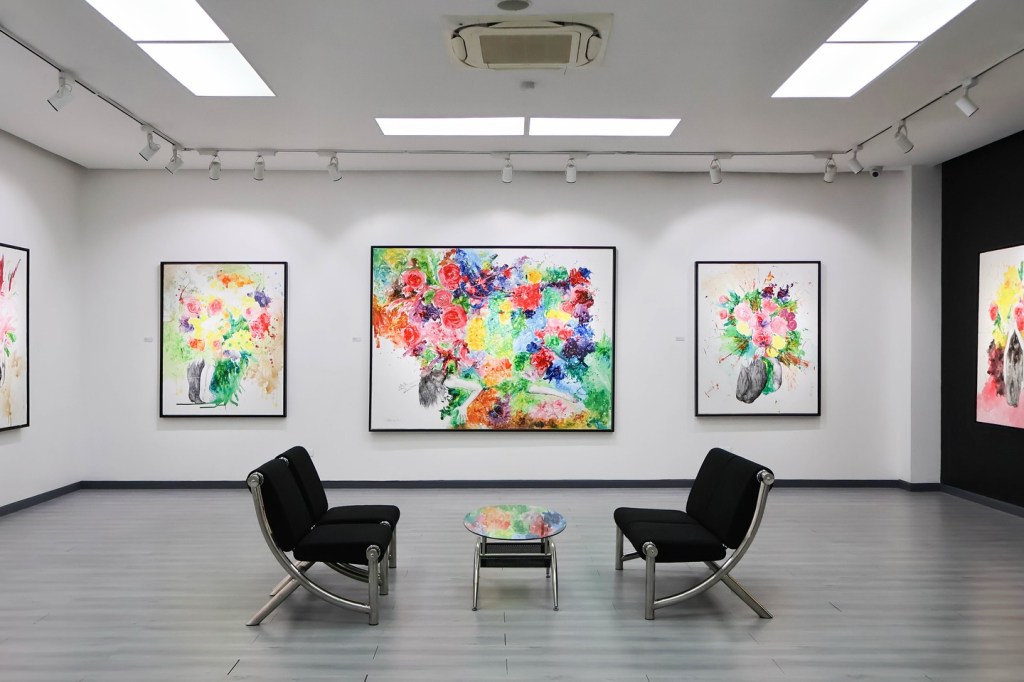

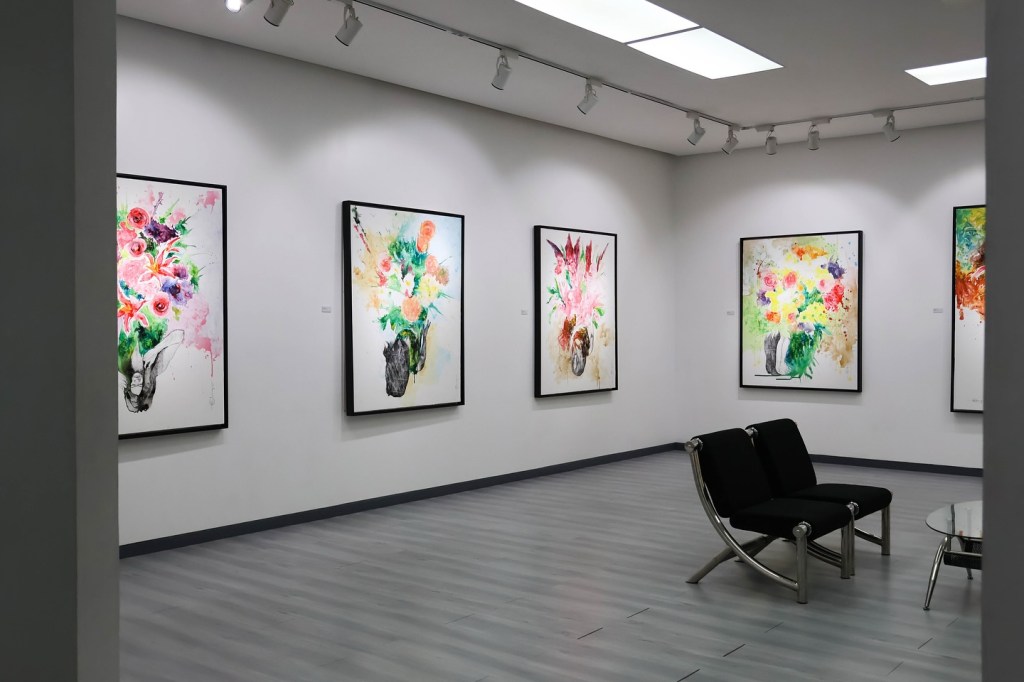


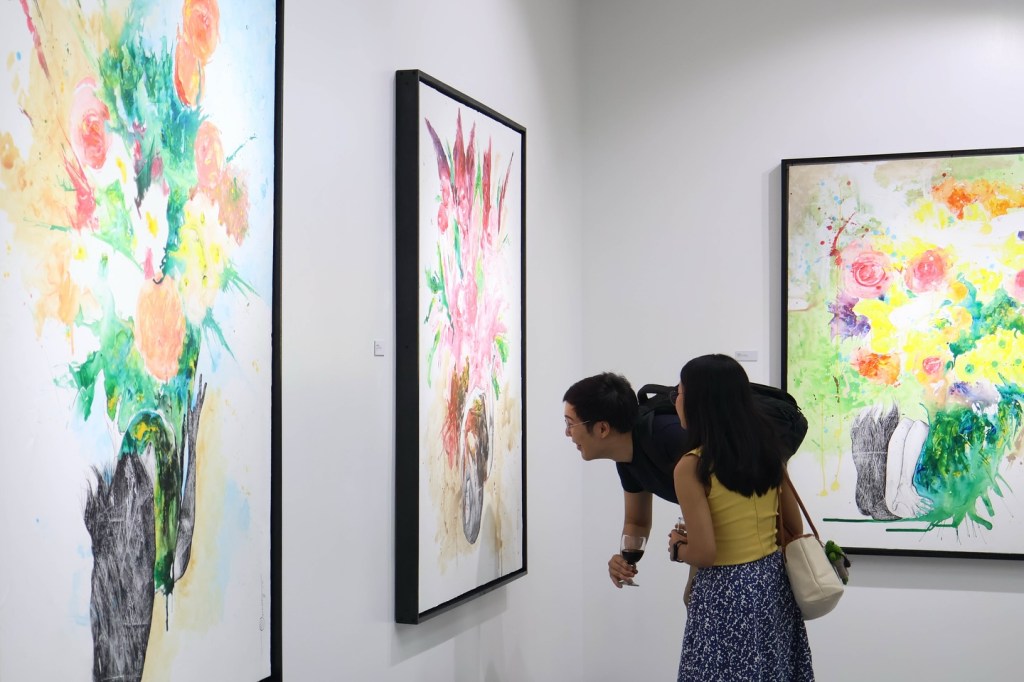


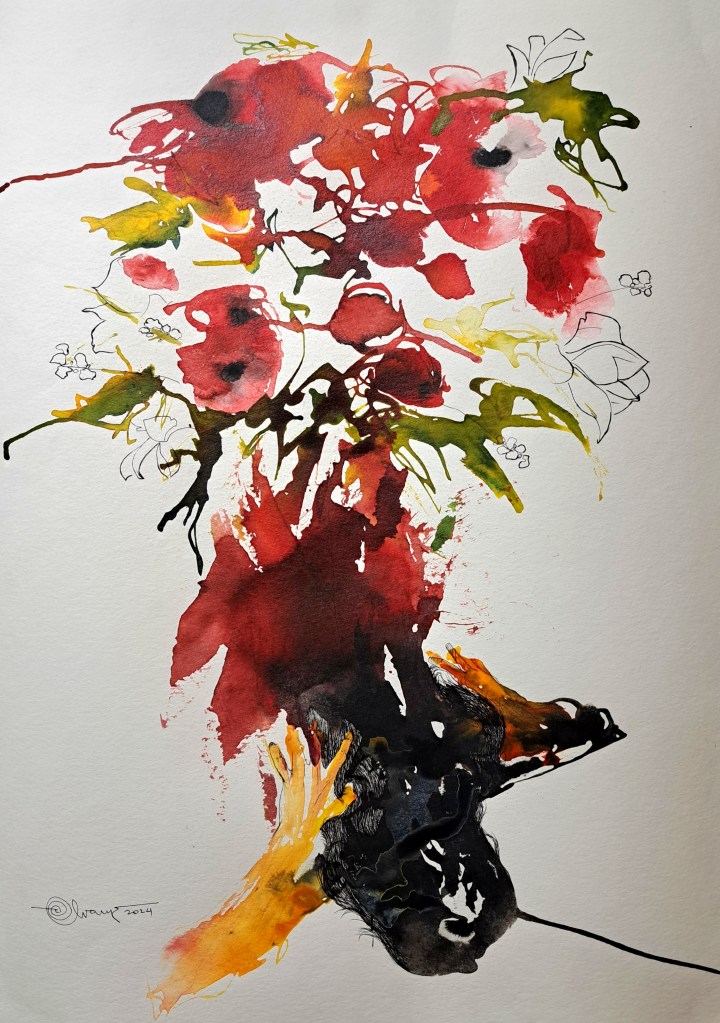
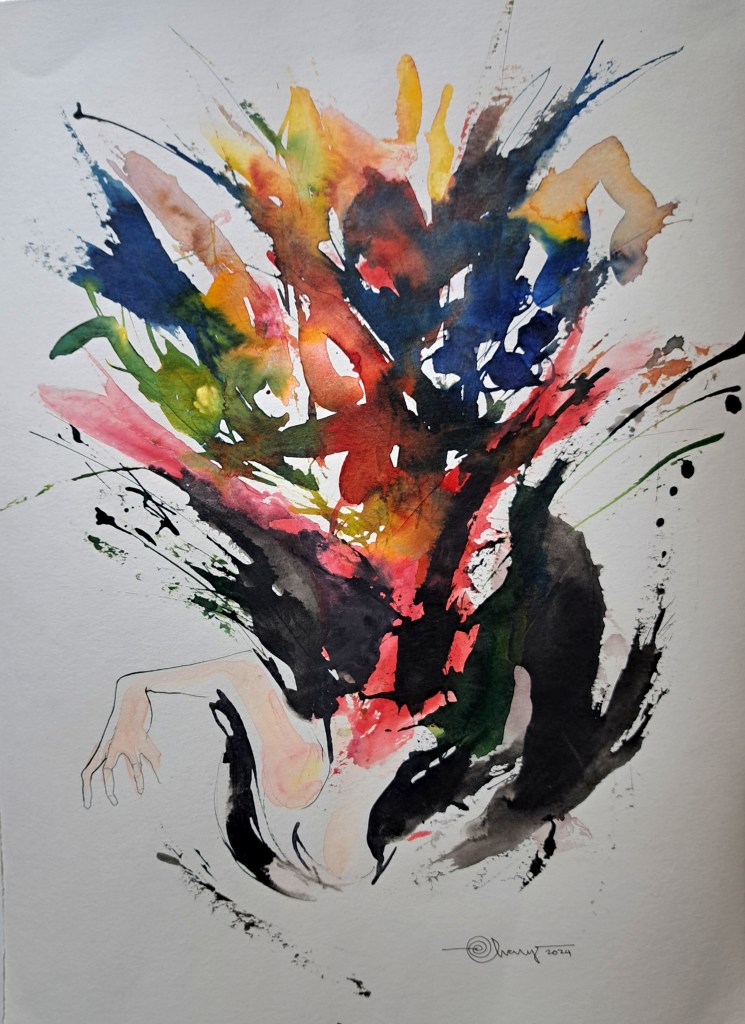
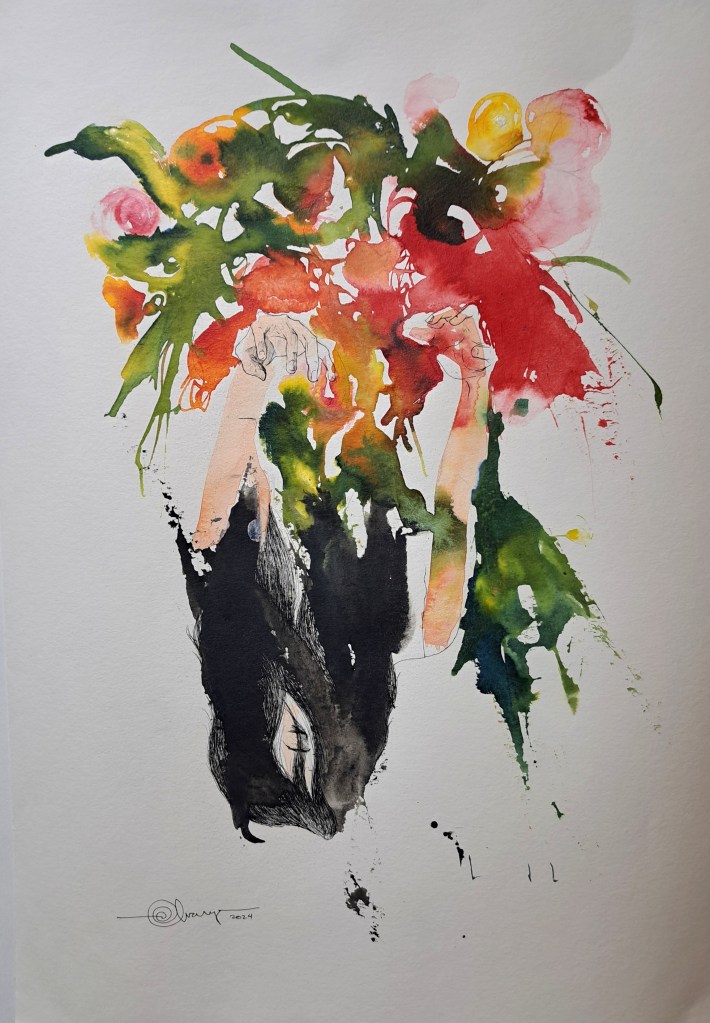
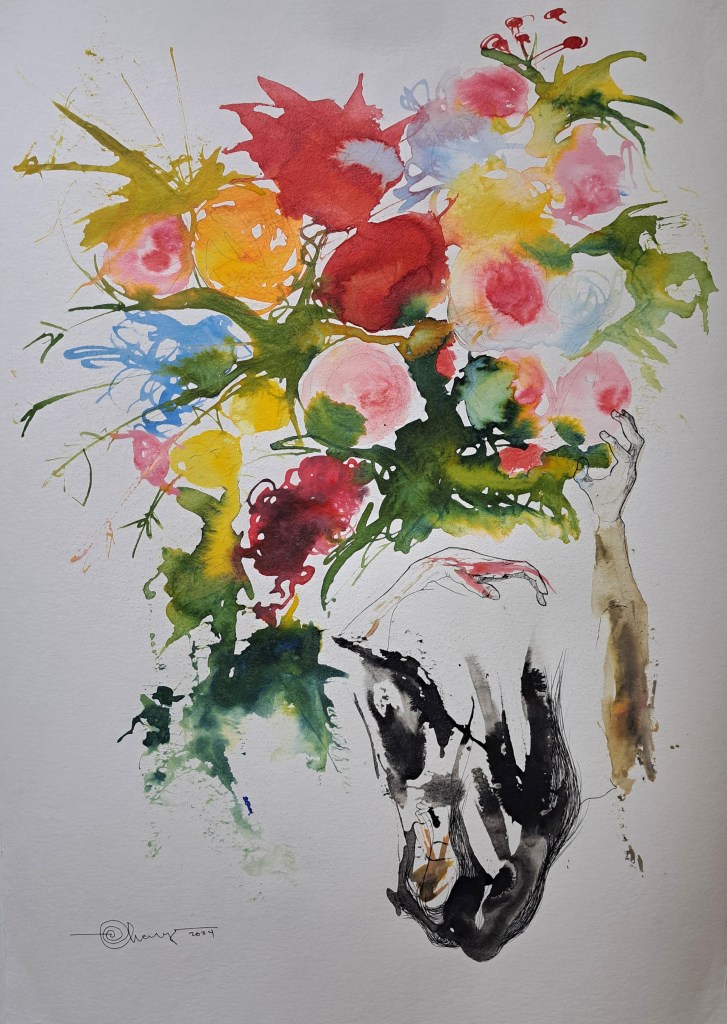
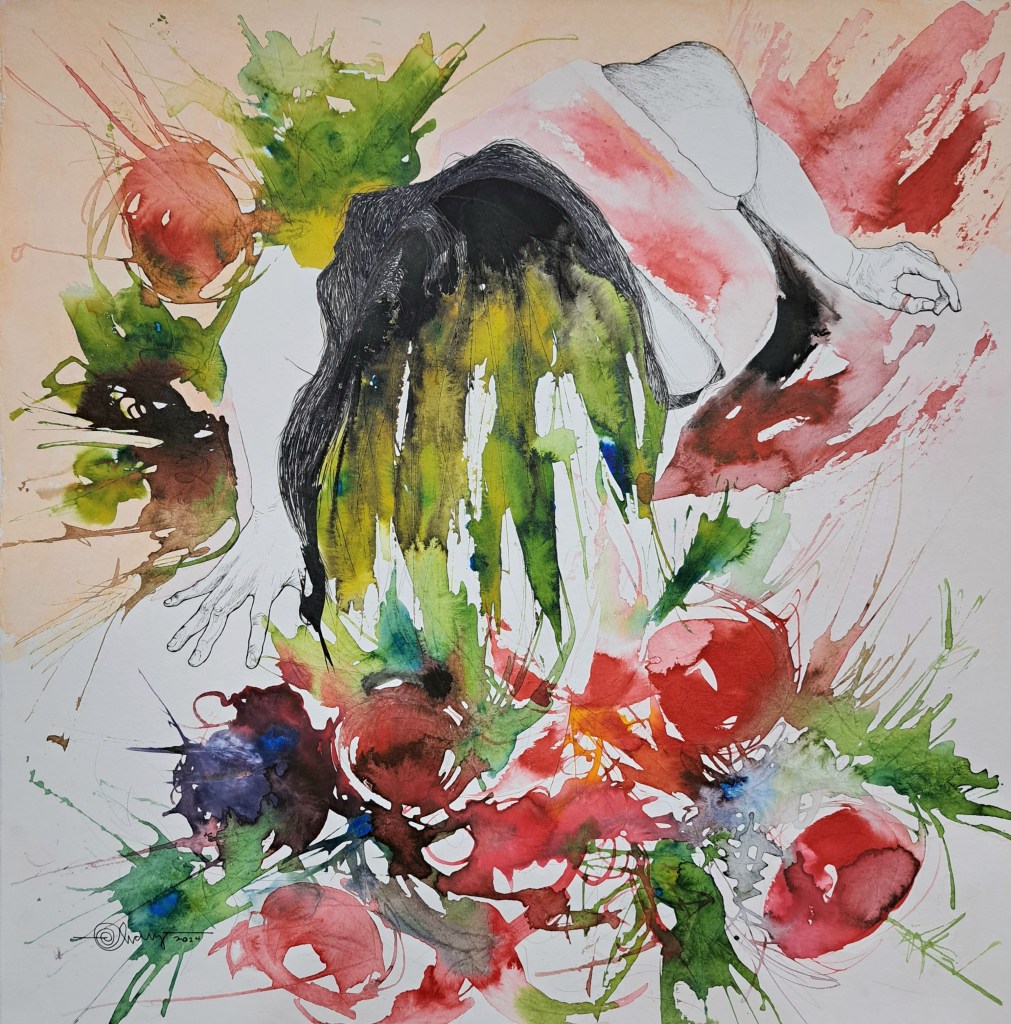
Ang lakas ng kontrast ng pigura ng ina at ng mga bulaklak. Ang itim na guhit ni Pancho sa ina ay totoong sumasalungat sa masayá at makulay na ayos ng mga bulaklak. Ang mga bulaklak, sa totoo lang, ay hindi mo makikilala kung rosas, o ilang-ilang, o liryo. Impresyonista ang pagkaguhit ng mga ito at makikilala lang sa hubog na tíla mga pabilóg na talulot. Samantála, ang tintang itim sa pagguhit ng kamay, paa, ulo, buhok, at dibdib ng ina ay mapaglimì at tiyak. Mga pinutol na bahagi ng nakahihilakbot na karanasan ng isang maysakit. At dahil lagìng nasa ilalim ay waring isinasaad ang pagsibol ng pag-asa mula sa pighati at pagdurusa. O kayâ, ang higit na mabigat na mensahe na kung walâng pighati ay walâng pagmumulan ang pag-asa.
– Virgilio S. Almario, National Artist for Literature
Dear Panch: Examining Panch Alvarez’ Pushing Up Flowers by Way of Ekphrastic Epistolary
By Mikael de Lara Co
Poet and Palanca Awards Hall of Famer
1.
First, a memory: First light peeking behind the curtains, the last guest gone, you reaching under the sink, rummaging through old bottles, hopeful for a couple more fingers of gin. For the road. Us sharing in the dregs and soon enough, you, slamming a fist on the table, tears in your voice.
Which is to say: There is tenderness in Pushing Up Flowers, and there is violence too.

PULSE
Acrylic and ink on canvas 2025
60 x 48 in
2.
I read your accompanying essay with interest. I know much of the narrative– the toxic ex-girlfriend, enamored with blades; the collapse of old friendships; the subsequent self-exile to Naga; the fascination with storms; your mother’s sickness; the amorphous, often dreadful, unnameable thing always hiding beyond the horizon.
Examining the paintings in your collection, staring at them for long minutes, then looking away, walking away as I hold them in my mind, returning for another look, I ask myself: Do I see these in them? I am not sure I do.
I know, however, that these things did happen, and so I see them for what they are: As context, a coagulation of scenes and situations, an entire universe (amorphous, often dreadful, unnameable) that the canvas can barely keep at bay. They exist in the flick of the wrist, the burst of force. “Largely intuitive,” you said when asked how you chose the colors, the directions of the splotches, the jaggednesses. Meaning, through impulse and mystery, rage and regret, gentle afterthought, memory blurred by sentiment.
But then again, I see, too, Tita Lays– clutching at her abdomen, or straining to get up. I see her hands en route to a face concealed by a thick shock of hair, the pain both assumption and foregone conclusion. I see the fine point of the pen, the negative spaces, each flowing strand, each whorl on weatherbeaten skin.
I see the flowers, and I see Tita Lays not so much pushing them up but keeping them upright, allowing them structure, allowing them form, not so much wild soil but a vase– the subject of thoughtfulness, molded and set down on a furnace and delicately held, almost always on the verge of shattering. An encasement less violent, less mortal than the blooms they contain. I remember the poet Eric Gamalinda and his words: “Just like the perfect seasons/ they will die/ and I will die/ and you will die also;/ no one knows who will go first,/ and this is the source/ of all my grief.”
This is, perhaps, a tension we are all called to endure. We are called to endure many things, as you know.

WHY
Acrylic and ink on canvas 2025
60 x 48 in
3.
I wonder, sometimes, about the fact that our friendship has, without doubt, enjoyed a surplus of laughter, despite all that we have had to endure. Is it artifice? Are we averse to intensity, afraid to dig into our chests and lay our hearts bare? Is it fear? I hope not.
Here is what I believe: That there are seeds within us that threaten, all the time, to rage into color, and we should count ourselves fortunate if, at some point, we are able to find our own encasements, our own ways of remaining taut without snapping, of keeping upright as we make sense of our own mortality and of the world.
Perhaps this is what is sometimes called beauty. Perhaps this is what is called art.
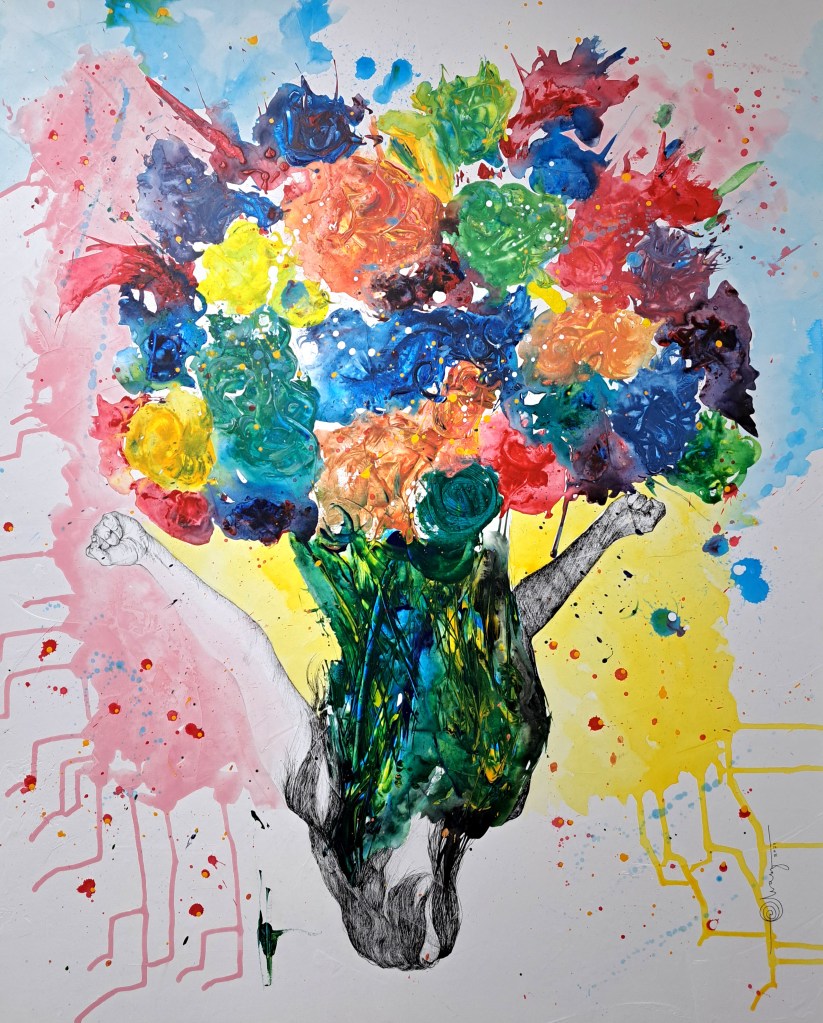
DISCHARGE
Acrylic and ink on canvas 2025
60 x 48 in

DISCOMFORT
Acrylic and ink on canvas 2025
60 x 48 in
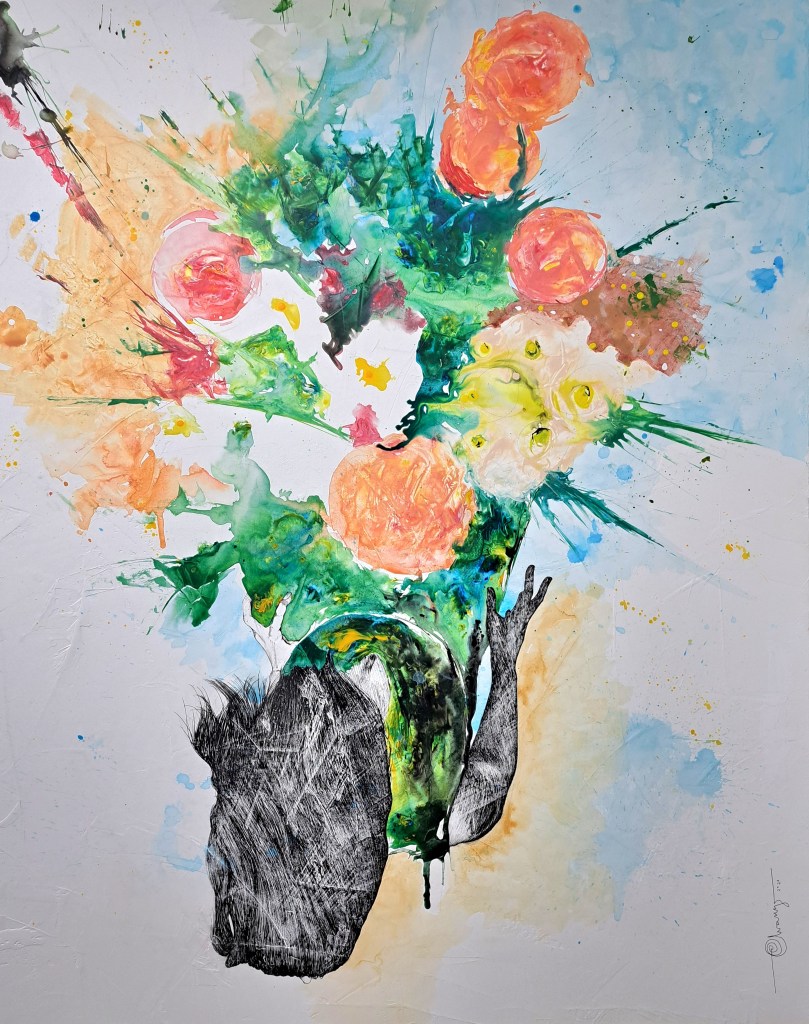
STANDING
Acrylic and ink on canvas 2025
60 x 48 in






Get in touch!
Thank you for your response. ✨

 The portfolio website of Panch Alvarez