
An average of twenty typhoons enter the Philippines each year, and about 90 percent of them strike the Bicol Peninsula.
Growing up in that region, we Bicolanos endured weeks (if we were lucky) or even months without electricity. Our nights were darker than most parts of the country. As a child, when the moon did not appear, I would stay indoors with my cousins to share ghost stories or make shadow animals with our fingers in the candlelight.
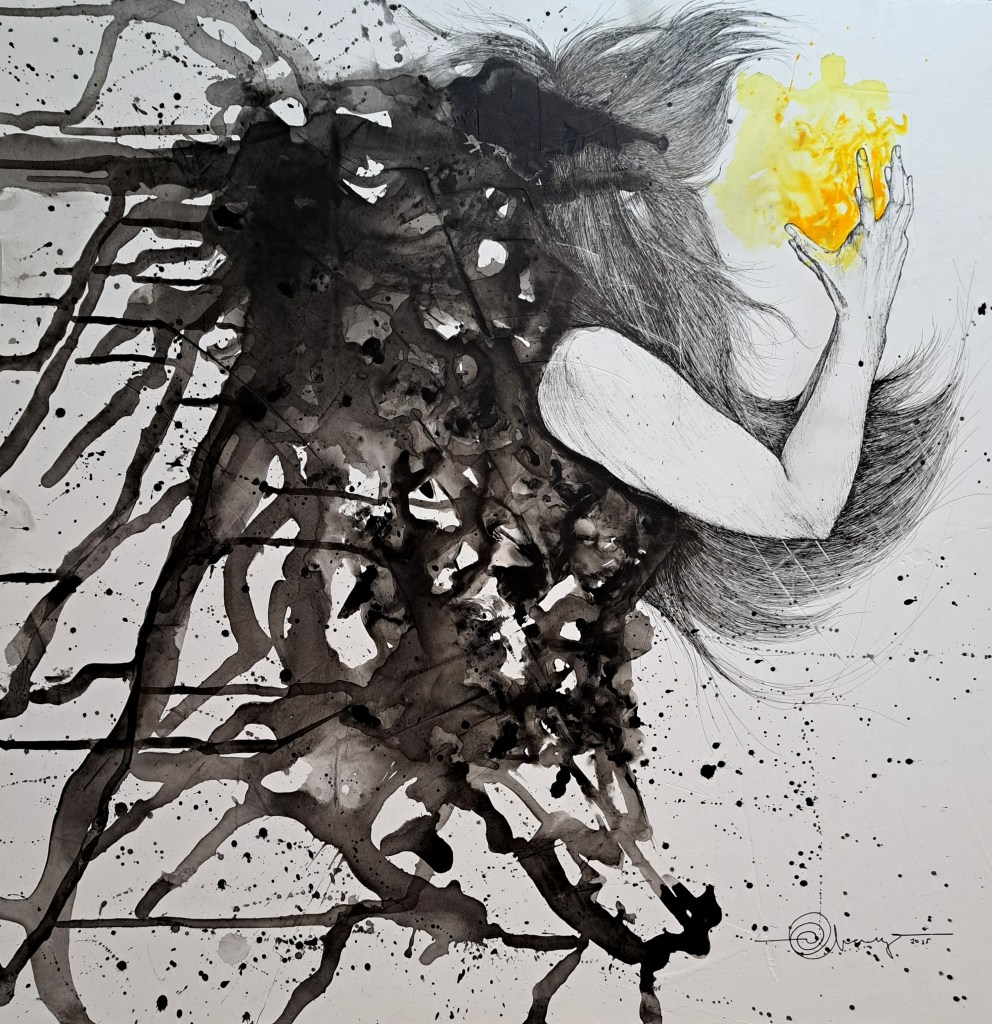
Ink and acrylic on canvas
36 x 36 in, 2025
Years passed, and I am now based in Manila. Here, there is always electricity, even during and after a storm. The bright lights from buildings and billboards illuminate major streets, even when they are flooded.
Yet the fact remains: most of the typhoons entering the country batter the Bicol region. Whenever I hear news of storms, I remember my grandparents on their knees, forcing rags into the cracks of the front door to keep the floodwater out. I remember how the water looked— dark, like liquid asphalt. It reminded me of the sea at night.
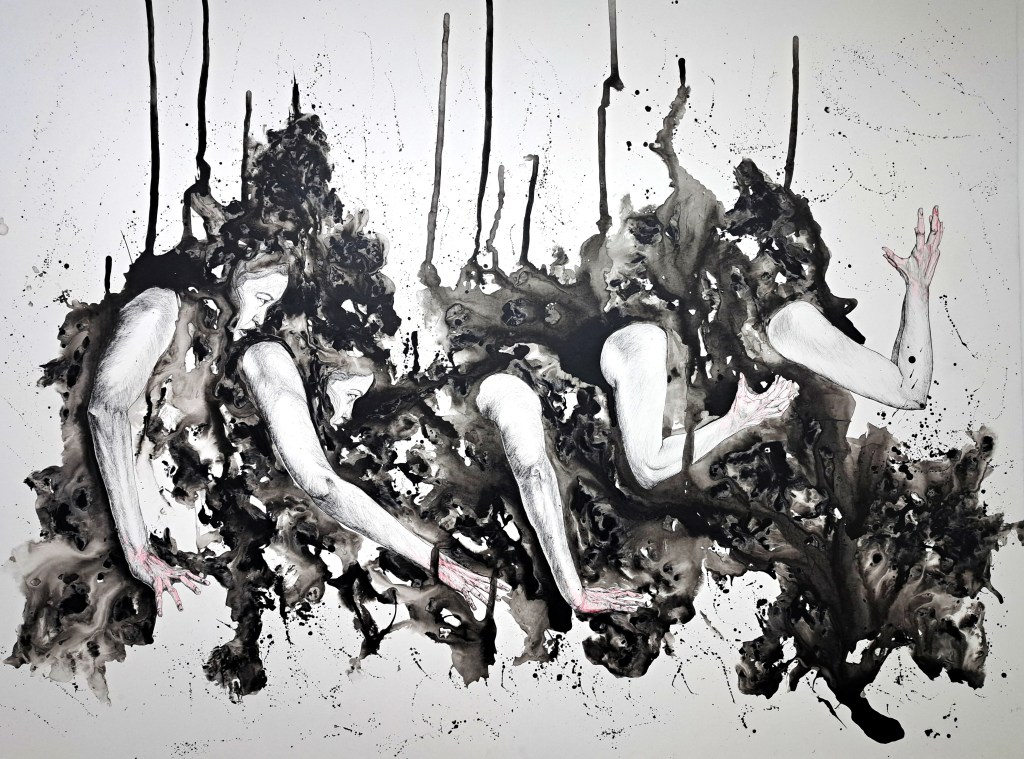
Acrylic and ink on canvas
72 x 96 in, 2025
Whenever we stayed overnight at a beach, I would sneak away in the evening and stare at the water. It always looked like a large mass of tar moving. I have forever been afraid of this sight. Water transforms in the absence of light.
So when my friend and mentor Alee Garibay released the first drop of ink on a sheet of water- soaked paper, I felt that same fear. I thought, that looks just like water in the dark.
For two years since Alee taught me this technique, I have tried to understand how color behaves in water. I would drop mixture after mixture, experiment with different liquids, and manipulate various surfaces. I stopped only when I achieved that same uneasiness I felt when staring at the sea or floodwaters at night.
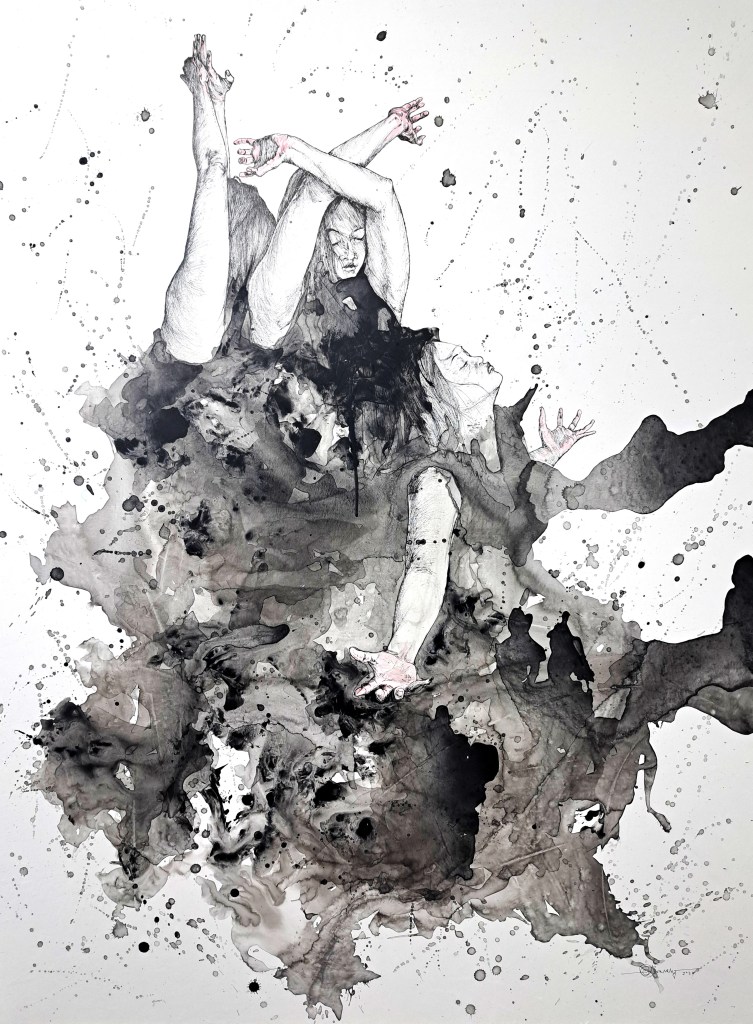
Ambon Lang
Acrylic and ink on canvas
48 x 36 in, 2025

Acrylic and ink on canvas
48 x 36 in, 2025
The artworks Ahon, Ambon Lang, Lusong, and Dahan-dahan are part of a collection titled Crooked Fingers.
Crooked Fingers speaks of the Filipino struggle against the climate crisis, particularly the devastation brought by Tropical Storm Kristine (Trami) in the Bicol region.
Bicolanos are no strangers to typhoons. We always find a way to rebuild as quickly as possible.
But Kristine was different. It left people stranded on rooftops for several days without food, water, or toilets. People badly needed rescue. Government officials mounted their boats, braved the murky floodwaters, and handed out 500 pesos to the stranded.
Ink on paper
36 x 36 in, 2025

Ink on paper
36 x 36 in, 2025

Ink on paper
36 x 36 in, 2025
This is the idea behind Crooked Fingers. It is not only about the lack of empathy and sensitivity from our leaders. It is about how, in the midst of great suffering, we allow them to make fools of us.
Crooked Fingers is not just about malicious governance but about our tolerance for their pambabastos—and our own twisted sense of self-respect.
As for its blotted aesthetic, it resembles my experience of water stripped of light. This sight has always been familiar to me, growing up in Bicol, the land of cyclones and month-long blackouts. I grew up playing with shadow animals formed by candlelight, with crooked fingers. And I will return, an adult now, to teach my nephew the same, because we have allowed ourselves never to escape the storm and the darkness.
Exhibit notes
By Jose Tence Ruiz
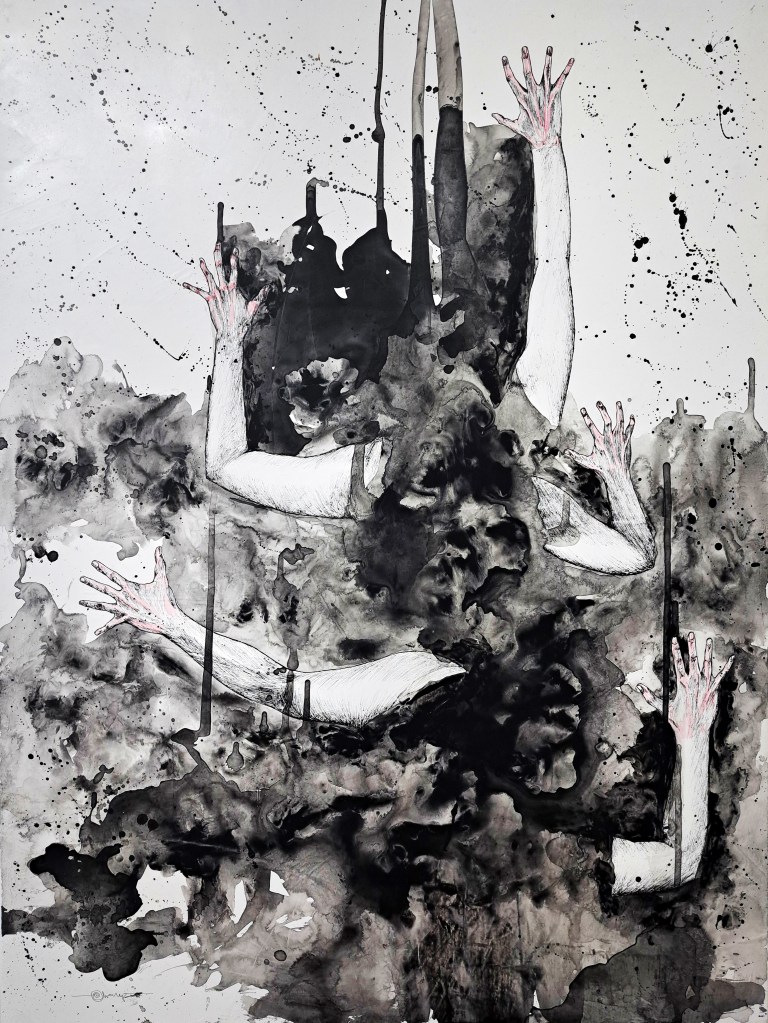
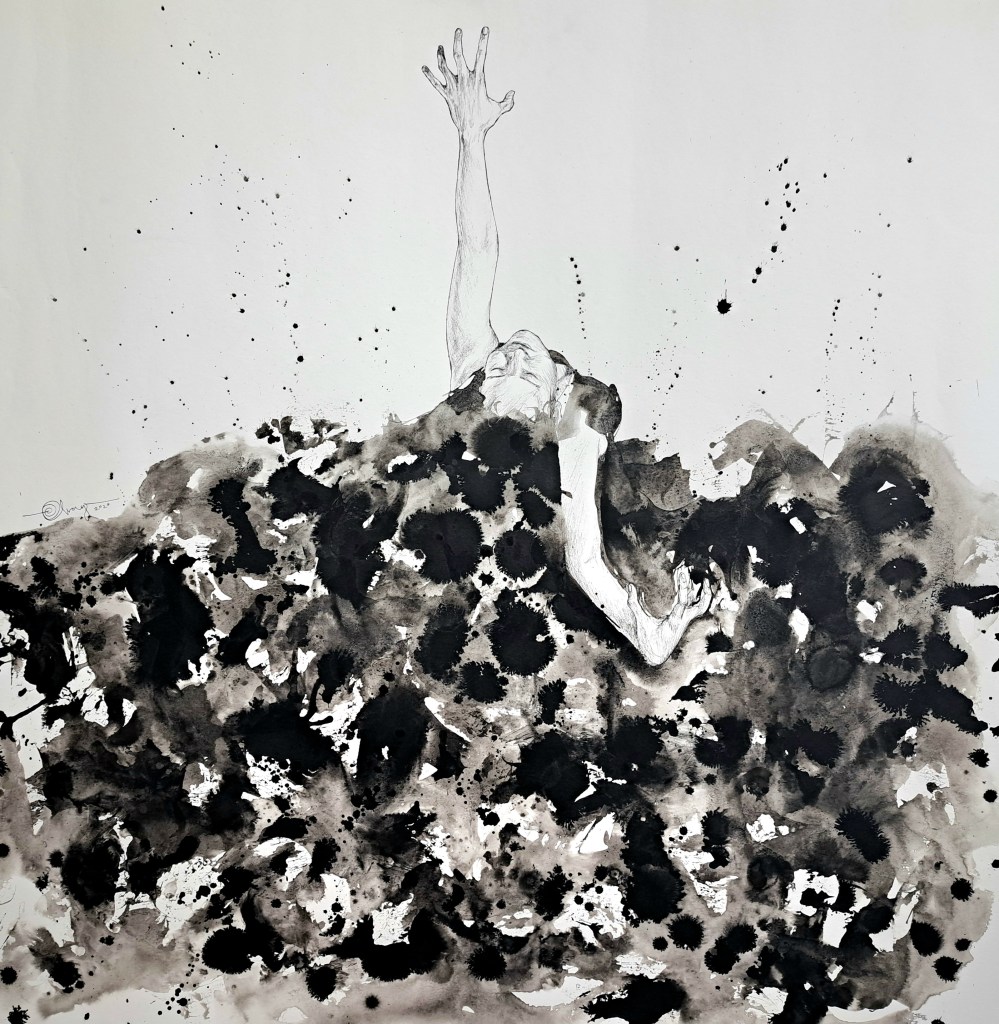
Lusong
Acrylic and ink on canvas
48 x 36 in, 2025
Panch Alvarez confronts the thought, the dread, the horrific anguish of drowning. He literally inundates his large works with engineered but quasi random splashes from which survivalist limbs barely but bravely emerge, clawing at a sense of struggle, resistance and grit. This organizer/teacher/observer laments both nature and the twists that human structures have accompanied it with, indexing the fate of his beloved Bicol as the fated doormat of the mid-annual storm cycles of renewal and devastation, the deluge of both calamity, self-serving patronage and corruption as well as the unsinkable spunk with which the Bicolano, or most humans in our age of climate disruption in the flood fights, head under and above water, to absorb and resist obliteration in this maelstrom of natural and bureacratric submersion.
Panch references both 1950s action painting and a hint of Ernst’s decalcomania, grafting his compositions with renderings of human appendages in the overwhelming swirl of enduring, his tribute and acceptance of the fate not only of his own birthplace, but of a human condition that harks back to the myths of Gilgamesh and Noah, that of nature both purging, cleansing and testing our will, our dominance on terra firma, our right and reward to be, resilient and rightfully balanced as the stewards of the terrible beauty that we have come to call Mother Nature.
 The portfolio website of Panch Alvarez